

1. What is Cancer
A Simple, Science-Backed Explanation.
Cancer is often spoken about as a single condition, but in reality, it is a broad term used to describe many different diseases. What they share in common is a change in how certain cells behave — growing, dividing, or surviving in ways the body did not intend.
In a healthy body, cells follow a natural rhythm: they grow, do their job, and make space for new cells when their work is done. Cancer begins when this rhythm is disrupted.
2. How Does Cancer Begin?
You may wonder how something so complex develops.
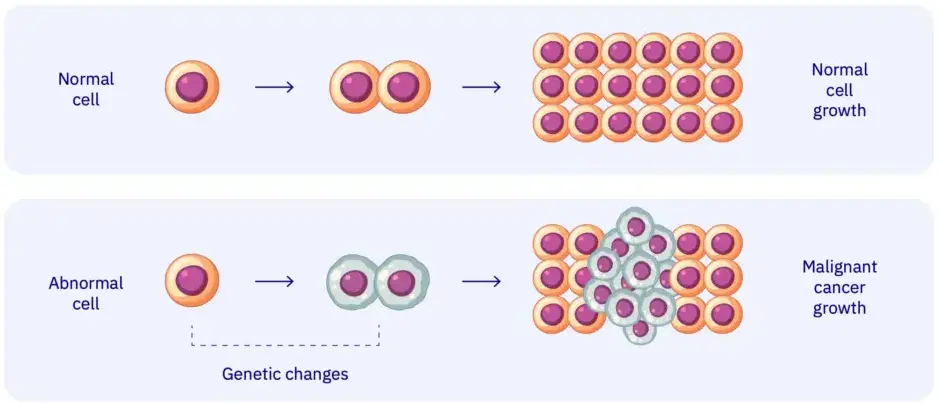
Cancer usually starts at a microscopic level. Over time, certain cells acquire changes that allow them to:
Grow when they normally would not
Continue dividing without usual controls
Avoid being cleared away when damaged
These changes often occur gradually and silently, sometimes over many years.
3. Is Cancer One Disease?
Not exactly.
Cancer is an umbrella term for many different conditions, each defined by:
Where it begins in the body
The type of cells involved
How it behaves and progresses
This is why two people with different cancers — or even the same cancer — may have very different experiences.
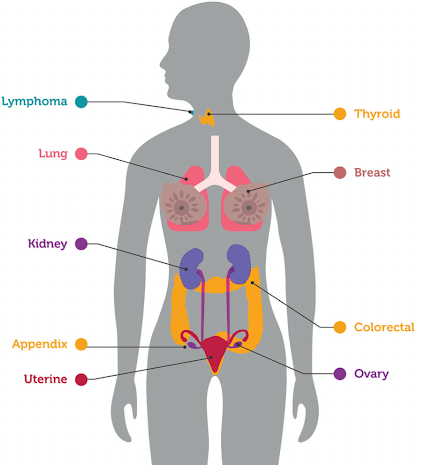
This image shows that cancer can start in many different parts of the body. It highlights common areas where cancer may develop, such as the lungs, breast, thyroid, lymph nodes, kidneys, colon and rectum, appendix, uterus, and ovaries.
The image helps explain an important idea: cancer is not one single disease. It is named based on where it begins and the type of cells involved. Even though all cancers involve abnormal cell growth, each location in the body can behave differently and may need a different approach to treatment and care.
By visually mapping these areas, the image supports a clearer understanding of how cancer can affect different organs, and why each person’s diagnosis, treatment plan, and experience can be unique.
4. What Causes Cancer?
There is rarely one single cause.
Most cancers develop due to a combination of factors, which may include:
Genetic changes (some inherited, many acquired over time)
Environmental exposures
Lifestyle factors
Natural aging processes
In many situations, the exact cause cannot be clearly identified — and that uncertainty is a known part of cancer science.
5. Common Myths About Cancer
“Cancer always runs in families”
Most cancers are not inherited. Only a small proportion are linked to known genetic mutations.
“Cancer always spreads quickly”
Some cancers do spread, but many remain localized, especially when detected early.
“A cancer diagnosis always means life is immediately at risk”
Not really! Today, many people live for years — and sometimes decades — while managing cancer as a long-term condition.
“Cancer can be Contagious from someone else”
Cancer is not contagious and cannot be passed through touch or proximity.
“Tests or biopsies can cause cancer to spread”
Diagnostic tests and biopsies are standard medical tools used worldwide. They do not cause cancer or increase its spread. Avoiding evaluation due to fear may delay diagnosis.
6. Can Cancer Be Prevented?
Not always. However, research shows that risk can sometimes be reduced by:
Avoiding tobacco
Limiting alcohol intake
Maintaining a healthy body weight
Eating a balanced, nutrient-rich diet
Participating in recommended screenings
Prevention focuses on risk awareness, not certainty.
7. Living With and Beyond Cancer
References
This content is aligned with information from:
American Cancer Society
Mayo Clinic
National Cancer Institute (NCI)
NCCN
World Health Organisation (WHO)
Prevention focuses on risk awareness, not certainty.